
The lockdown that crippled the entire logistics, delivery and supply chain network to near zero, was enough to deal a body blow to India's fastest growing unicorn whose very business model saw a severe disruption, like several other firms and sectors.
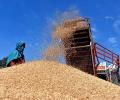
India is looking to tap its diplomatic missions abroad to enable grain exporters in the country to ship out wheat and corn as supplies from Russia and Ukraine are expected to remain disrupted for some time to come. Between the two items, pushing for wheat is easier because of a huge domestic surplus. "We are hand holding our exporters and support from various Indian missions abroad is also being channelised accordingly," a senior government official said. Global wheat prices have jumped since the Ukraine crisis started, with wheat futures in the US reaching their highest levels since 2008.

The Reserve Bank's rate setting panel on Thursday met to finalise a report for the government on why it failed to keep retail inflation below the target of 6 per cent for three consecutive quarters since January this year, said sources. The report will be presented to the government as per the Reserve Bank of India Act, they added. The six-member Monetary Policy Committee (MPC) is headed by Governor Shaktikanta Das.

Australian Foreign Minister Marise Payne and Defence Minister Peter Dutton from the Australian side will meet with External Affairs Minister (EAM) S Jaishankar and Defence Minister Rajnath Singh.

Maruti Suzuki India (MSI) and Hyundai posted single-digit growth in domestic sales in June, even as the overall passenger vehicle segment crossed the 20 lakh units sales mark for the first time-ever in the first half this year. Toyota Kirloskar Motor reported a double-digit growth in dispatches to dealers, while Kia saw a dip in wholesales last month. MG Motor India also reported a double-digit increase in retail sales in June 2023 compared to the same month last year.

Indonesia, the world's biggest supplier of palm oil, said on Thursday it will lift a ban on exports from Monday, likely helping India and other importers. India annually imports around 13-13.5 million tonne of edible oils, of which around 8-8.5 million tonnes (around 63 per cent) is palm oil. Of this, 8-8.5 million tonnes of palm oil, 45-50 per cent comes from Indonesia and the rest from neighboring Malaysia.

Suppliers to Apple Inc are scrambling to get enough screens ready for the new iPhone 6 smartphone as the need to redesign a key component disrupted panel production ahead of next month's expected launch, supply chain sources said.

The government has decided to postpone the release of the new Foreign Trade Policy (FTP) and extend the existing one by six months on account of global uncertainties and currency fluctuations. The government was scheduled to announce the new FTP by the end of September. The current policy was to end on September 30.

Investors have scaled back their allocation to equities as pessimism has reached "dire" levels due to cloudy economic outlook, according to the latest Bank of America (BofA) monthly global fund manager survey that covered nearly 300 money managers with combined assets of $800 billion. The survey showed that the expectations for global growth and profits are at all-time lows and cash levels are at highest since the 9/11 attacks. Interest rate hikes by central banks, the unwinding of an easy monetary regime, disruptions in global supply chains, and fears of recession have heightened market volatility since the beginning of the year.

'Investors should reduce cash gradually and look for value investing.'

Singaporean brokerage DBS said in a report that it expects exports to pick up once the GST-driven distortions subsided, but it warned that the traditional product mix will hinder its ability to participate in the ongoing trade upturn.

India's inflation trajectory in the coming months will be influenced more by the geo-political situation due to the war in Europe and its impact on supply chains and commodity prices. However, the country is better placed than most to "weather the storm" and achieve growth of close to 8 per cent in the current fiscal year, the finance ministry said in its latest monthly economic report on Thursday. "Through the channel of imports, elevated global crude and edible oil prices now have a significant impact on India's inflation outlook. "Government measures to keep the prices of these commodities in check, along with the recent hike in policy rates by the RBI, are expected to temper inflationary pressures in the economy," the monthly economic report for April, drafted by the finance ministry's economic division, said.

China's GDP grew by 4.9 per cent in the third quarter, down from 7.9 per cent in the second, confirming the slowdown of the world's second-largest economy which was under pressure from the crisis-hit property sector, curbs on energy and tardy recovery from the Covid-19 pandemic.

At the annual general meeting of Reliance Industries earlier this week, Isha Ambani, director at Reliance Retail Ventures, announced that the company is foraying into the fast-moving consumer goods (FMCG) space. But analysts say that only time will tell if this will lead to a disruption in India's FMCG market. While Reliance Retail's initial strategy is to take its own brands, which it currently sells at its own supermarkets and hypermarkets, to general trade, it is also looking at acquisitions.

Imports too contracted by 28.72 per cent to $31.16 billion. Dip in exports and imports narrowed the trade deficit -- the difference between imports and exports -- in March to $9.76 billion, the lowest in the last 13 months.

Stocks of Indian companies with exposure to Europe fell on Tuesday amid concerns about the impact on their sales in case the Russia-Ukraine crisis worsens and the US and its allies impose economic sanctions on Russia. While top conglomerates, including Reliance Industries, the Tata group, and Aditya Birla Group, said they did not have any significant exposure to Russia, executives of some of the oil and gas, pharmaceutical, and tea companies said they were monitoring the situation closely as they earned substantial income from the region. Russian President Vladimir Putin on Monday ordered troops into two breakaway regions of eastern Ukraine after announcing that Russia would recognise their independence.

Export of mango, especially alphonso, to European countries has been negligible this season; shipments to the Gulf fell 40-50 per cent.

Ramdev made nature-to-goodness products popular, and reaped benefits. Then he seemed to lose focus and the last thing it needs is more distraction, like the passionate founder shooting his mouth off yet again

From the rollback of customs duty on key electronic components to fast tracking delivery of goods imported from China, players are looking for incentives on several counts.

When Open Network for Digital Commerce (ONDC) was conceived last December, the idea was to reduce the dominance of e-commerce giants like Amazon and Flipkart. It was also to bring in a level-playing field for small merchants in India's fragmented but fast-growing $1-trillion retail market. However, those goals have changed now as large e-commerce players such as Flipkart, Amazon and Ecom Express are in various levels of talks with the ONDC team. They want to form partnerships like integrating with the network as well as providing their expertise to build it, according to the industry sources.

'Tens of millions will be working from home for months at a time, which means the smartest brains in business will be focussed on creating more efficient WFH processes,' predicts Devangshu Datta.
The Reserve Bank is likely to maintain status-quo on the key interest rates for the third time in a row in its upcoming bi-monthly policy review despite the US Federal Reserve and the European Central Bank hiking benchmark rates, as domestic inflation is within the RBI's comfort zone, say experts. The borrowing cost which started rising in May last year has stabilised with RBI keeping the repo rate unchanged at 6.5 per cent since February when it was raised from 6.25 per cent. In the previous two bi-monthly policy reviews in April and June the benchmark rate was retained.

Imports too tumbled by 58.65 per cent to $17.12 billion in April from $41.4 billion in the same month last year, according to the data by the commerce and industry ministry.

'There is a lot of interest from potential clients who have remained away from the markets in past years.' 'They are evaluating whether this is a good time to enter, especially since there are very few alternatives to earn meaningful returns.'

Moody's Investors Service on Friday said India's economy is expected to contract for the first time in more than four decades saying economic damage owing to the coronavirus-induced lockdown will be significant with lower consumption and sluggish business activity. Even before the coronavirus outbreak, Indian economy already was growing at its slowest pace in six years and with the stimulus measures announced by the government falling short of expectations, the disruptions are likely to be greater. "We now expect India's growth to register a real GDP contraction for the fiscal year ending in March 2021 (fiscal 2020-21), from our earlier projection of zero growth," it said in a research note.

India's economy is expected to grow 7.5-8 per cent this fiscal year with exports playing a key role in the country's success story, CII president TV Narendran said on Monday. However, he said the country needs to remain prepared for any fallout of next wave of COVID-19 pandemic, and the impact of the ongoing Russia-Ukraine war. "We are confident that the economy can retain a high growth trajectory this year. "So, we are very optimistic on the export front. "Exports will be a key component of India's success story going forward," Narendran said.

Amid the ongoing festival season in the country, the hiring of gig workers has zoomed across sectors as the businesses have begun opening up leading to an uptick in consumer sentiments and rising pent-up demand, according to experts. "In the third quarter, with the onset of festive season, we are witnessing a 400 per cent spike in the hiring for gig workers. Earlier, in the first quarter of this year, as many businesses and companies were not operating at full strength, growth was muted. "However, things began picking up and became more promising from the second quarter, as the demand for gig workers across sectors grew," Taskmo, a subsidiary of Quess Corp, co-founder Prashant Janadri told PTI.

Corporate margins and profits in India remain vulnerable to changes in crude oil prices in the international market. Historical quarterly data from listed companies (excluding banks, finance and insurance, oil and gas, and power sectors) indicate an adverse correlation between corporate margins and crude oil prices.

Amid rising geopolitical risks, a vast majority of Indian CEOs have indicated in a survey that they are reducing or planning to reduce operating costs, even as they are more upbeat than their global peers on their country's economic prospects. However, most of the companies do not plan to cut their headcount or salaries, found the annual Global CEO Survey released by consultancy giant PwC here on the first day of the World Economic Forum meeting on Monday. The survey also found that about four in ten CEOs (40 per cent of global and 41 per cent of India respondents) do not expect their companies to be economically viable in 10 years if they continue on their current path.

Retail inflation slowed to 4.29 per cent in April from 5.52 per cent in March, mainly due to easing food prices, government data showed on Wednesday. The Reserve Bank mainly factors in the retail inflation based on Consumer Price Index (CPI) while arriving at its monetary policy. As per the data released by Ministry of Statistics and Programme Implementation, inflation in the food basket was 2.02 per cent in April, down from 4.87 per cent in the preceding month.

Reliance-Google's new smartphone has got mixed reviews from analysts and brokerages. The phone pricing is seen unattractive for low-end customers and bundled offers are being viewed as non-disruptive. While this could slow the pace of adoption, it could set the stage for tariff hikes in the industry, feel analysts.

The additional outgo to combat the impact of COVID-19 will significantly erode the fiscal consolidation achieved by the state governments in the past three years, an RBI report said on Tuesday. In its study of the state budgets of 2020-21, the RBI report which has dwelled on the theme 'COVID-19 and its Spatial Dimensions in India', said that Gross Fiscal Deficit (GFD) of the states would spiral during the current fiscal.

Non-banking finance companies face renewed asset quality and liquidity risks amid a second wave of COVID-19, Fitch Ratings said on Thursday. These challenges are likely to increase if recent restrictions to contain the pandemic are expanded or prolonged, leading to greater economic and operational disruption, it added. The rating agency further said that an increase in the rate of infections and broadening of social distancing restrictions pose downside risks to its 12.8 per cent growth projection for the current fiscal.

The car was expected to have a price tag of Rs 10 lakh and launch was slated for this June.

Developed countries are relaxing restrictions on economic activity at a faster rate than expected. Global demand for consumer goods, intermediates and commodities is growing at a fast pace. Most exporters are flushed with orders, says T N C Rajagopalan.

Though leading brands like Samsung, Apple, Xiaomi, OnePlus, and Oppo managed to absorb the initial lockdown shock and resumed their local production back to 60 per cent, they would likely suffer a 20-25 per cent loss of sales in the October-December quarter.

Continuing its heavy selling spree for the eighth consecutive month, foreign investors pulled out nearly Rs 40,000 crore from the Indian equity market in May on fears of an aggressive rate hike by US Federal Reserve that dented investor sentiments. With this, net outflow by foreign portfolio investors (FPIs) from equities reached at Rs 1.69 lakh crore so far in 2022, data with depositories showed. Going ahead, FPI flows will remain volatile in the emerging markets on account of rising geo-political risk, rising inflation, tightening of monetary policy by central banks, among others, Shrikant Chouhan, Head - Equity Research (Retail), Kotak Securities said.

In spite of a severe second wave of the coronavirus pandemic, and a widespread disruption in public life therefore, India's fast-moving consumer goods (FMGC) sector seems to have emerged as one of the most resilient segments of the economy. The early numbers and estimates for the April-June quarter indicate a steady recovery in FMCG players' business, which is now set to exceed the pre-pandemic level. Amid nationwide lockdowns because of the first Covid wave, FMCG revenues had been severely affected in mid-2020.

Passenger vehicle majors like Hyundai, Tata Motors, M&M, Toyota Kirloskar and Honda on Wednesday reported growth in domestic sales in August riding on festive sentiments, although market leader Maruti Suzuki posted a decline amid a semiconductor shortage affecting the industry. The country's largest carmaker Maruti Suzuki India Ltd (MSIL) reported domestic sales at 110,080 units, as compared to 116,704 units in the same month last year, down 6 per cent. "Sales volume of the company in August 2021 was affected due to electronic components shortage.

The management changes come amid talks that the company is preparing for an IPO in the United States.
